Saturday, June 4, 2022

Creating a Substitute Folder for Your Sunday Church School Classroom


Small church schools are staffed with dedicated teachers, but perhaps there aren't enough volunteers for additional, supplementary roles such as teaching assistants and designated substitutes who could fill in when teachers need to miss a Sunday. Often, the improvised solution is to hastily combine classes (which doesn't always work well for the students and can overwhelm a teacher) or cancel class. By creating a Substitute Folder with a lesson plan and a few other helpful documents, a trusted lay person from the parish can confidently step in to cover on short notice.

Summer break is a convenient time to take care of administrative details for the upcoming church school year such as creating a substitute folder. Shared with permission from the Orthodox Church School Teacher blog is the post and corresponding image, "On Creating a Substitute Folder for Your Sunday Church School Classroom."

As Sunday Church Schools in the northern hemisphere prepare to begin a new SCS year, it is time for teachers to begin to ready their classrooms. An oft-overlooked piece that ought to be prepared before the start of the year is a “Substitute Folder.” It is unusual that teachers should miss a Sunday, and most times they are able to find and train their own replacement if they know they will miss a Sunday. However, once in awhile something comes up suddenly and even the most devoted Sunday Church School teacher must miss class at the last minute. This blog post will offer a few suggestions of how to prepare for that unlikely-yet-possible occasion.

In order to be ready for such a time as this, we recommend that every classroom have a “Substitute Folder” prepared. It should be easy to find, and/or the Sunday Church School Director should know where it is so he/she can gather it for the substitute. The folder does not have to be big or fancy: it can just be a simple three-pronged folder, clearly labeled “Substitute Folder.” It should contain the following:
1. A roster of students in the class. (And a seating chart, if you have assigned seats.)

2. An order or schedule of how class usually happens.

3. Helpful notes that the substitute can read quickly to learn more about the students in the class and/or tips that can help them succeed. (This will likely need to be written part way through the year, unless you know all of your students before the year begins.)

4. A lesson plan that can happen at any time of the year. It should be well thought through, and explained in a way that someone could just pick it up and read it while teaching it to the class.

5. Any books or other text that will be needed to teach the lesson.

6. All the photocopies and/or craft supplies (or directions on where to find them) that will be needed for the lesson.

7. An optional other activity or two, in case the substitute would need it to fill time. It could be a suggested related Bible or Saint story to read with/to the students; directions for a review-type game; a pencil and paper activity like a word search or crossword; or a drawing/writing challenge.

You may also wish to include a note to your class such as, “Good morning, class! I am sorry that I am not able to be with you this morning. Please welcome (substitute, insert your name here) who is filling in for me at the last minute. I look forward to being with you again next week, God willing, and will be excited to hear what you have learned in class today! May God bless your learning, and your week! With love in Christ, your Sunday Church School teacher”

It takes a little time and effort to prepare a Substitute Folder. However, the consistency that these plans will offer will ease the substitute’s job while also soothing the students. The one lesson in this folder may last you all year long, God willing, as long as it remains unused! But if for some reason you do need to use it at some point, at least you will be at peace knowing that your responsibility to your Sunday Church School students is taken care of, and that you have done all that you were able to do to teach them on that day.

Here are some links that you may find helpful as you prepare a substitute folder for your classroom:

***

This teacher wrote a detailed plan for preparing a sub folder. Intended for a regular school teacher, many of the ideas would also apply to a Sunday Church School classroom. http://www.cfclassroom.com/2012/01/how-to-prepare-for-sub-w-free_08.html

***

Here are some free printable pages that you can use as you prepare your folder: http://owlwaysbeinspired.blogspot.com/2013/08/sub-tub-and-sub-binder.html

***

This free ebook is geared to a regular school teacher, but many of its ideas apply to a Sunday Church School teacher as well: http://www.cfclassroom.com/2016/03/how-to-plan-for-a-substitute-teacher.html

***

You can purchase editable sub folders (geared to regular classrooms, but certainly usable by Sunday Church School teachers) such as this one: https://www.teacherspayteachers.com/Product/Editable-Substitute-Binder-Forms-for-your-sub-binder-or-sub-tub-2830294 or this one: https://www.teacherspayteachers.com/Product/Substitute-Binder-1926462

***

In your substitute teacher folder, you may want to include a sub’s report back to you about how class went while you were gone. If you do, here is a free printable that you could use to that end: https://www.teacherspayteachers.com/Product/Sub-Report-Form-for-Sub-Management-Binder-Substitute-Organization-Form-1592692

***

One possible resource for a lesson for your substitute teacher folder could come from one of these mini-units. Select a mini-unit that your substitute can share with your students and then prepare a lesson from that unit to add to your folder. Every mini-unit contains lesson ideas for a variety of age levels. See http://dce.oca.org/page/mini/ to find a mini-unit that would coincide well with your regular curriculum!

Monday, December 13, 2021

First Months of Popular "Let Us Attend" Resource Now Available for 2022


Shared from the Antiochian Orthodox Christian Archdiocese of North American website. The original article can be found here. 

Resources for the first few months of "Let Us Attend," one of the Archdiocese's most popular tools for Christian Education both at home and in the parish, are now available online. The program offers illustrated handouts of each Sunday's Gospel at five levels, along with discussion questions. It is paraphrased for the younger grades, and presented as it will be heard for the older students.

With engaging graphics and great questions, "Let Us Attend" can be used as the curriculum for a small church school or by parents who wish to read the gospel on Saturday night with their children. Two audio files offered by Ancient Faith Radio are also available each Sunday--one for the younger children, told by a master storyteller, and one for the older children, a reading of the Gospel.

View the Antiochian Archdiocese's Sunday Liturgical Readings Chart for 2022

"Let Us Attend" materials are digital and free for all to use. Available for immediate download. 

Tuesday, September 28, 2021

A Glimpse at the book “101 Orthodox Saints” by Sarah Wright and Alexandra Schmalzbach, Illustrated by Nicholas Malara

This book is newly released from Ancient Faith Publishing and will appeal to a broad age range of church school students, making it is a worthy investment for the library of a small church school. The review is shared with permission from the Orthodox Christian Sunday Church School Teacher blog, which is managed by the Antiochian Orthodox Department of Christian Education.


Ancient Faith Publishing has just released a gift to the English-speaking Orthodox Christian world. Wrapped in a sturdy hardcover and crammed with art, stories, and facts, this gift is the beautiful book 101 Orthodox Saints, written by Sarah Wright and Alexandra Schmalzbach, and illustrated by Nicholas Malara. This book is a breath
of fresh air, bright with color, alive with stories and facts, and filled to the brim with intrigue.

From its introductory pages, the photos and illustrations draw the reader in, and they become curious to learn more. What are saints? How does someone become one? What does it mean to venerate a saint? Who is called to be a saint? How can this book be used? All of these questions (and more) are answered in an engaging manner in the few pages at the beginning of the book.

The bulk of the book is a page-by-page alphabetical sharing of information about 101 carefully-selected saints from all regions of the world and from all generations, who cross both continents and time to breathe the life of Christ into the reader’s soul. An abridged version of each saint’s story is told on their page. The page also includes important details about the saint’s life (including a map of where they are from, several fun facts, and the dates of their birth and repose, as well as their feast day), their icon, and related photos. Artist Nicholas Malara’s rendition of each saint beautifully reflects their love for God and gives the reader a realistic glimpse into a moment of their life.

The authors have sorted the particular vocations of each saint, marking their page with simple sketches explained in a legend at the beginning of the book. (For example, St. Columba of Iona was a priest, a missionary, and a monastic so there are three sketches right under his icon that identify him as such.) This marking system allows readers to quickly flip through, find, and read about all of the saints that were royalty (or fools for Christ, hymnographers, wonderworkers, etc.). The book includes a beautiful timeline that places Malara’s illustrations in the order of when in time each saint lived. The authors have also included a glossary that is both thorough and accessible, along with an extensive index.

Young children will be mesmerized by the beautiful new friends they will see in this book. Some older children will flip through and read all of the fun facts, making connections between the saints in the book and the places and history they are learning about at school. Some will read the book from cover to cover. Even adult readers will “meet” new (for them) saints and be challenged to live in the same godly manner.

This book offers 101 refreshing glimpses into what a life truly lived for Christ can look like. Each of the 101 saints’ lives are unique, and they differ in many ways. But all of them share one thing in common: their complete dedication to and love for Christ.

It is a good thing that this book is so sturdily bound. Whether it belongs to a child, a family, a Church school class, a Church library, or a classroom, it will be poured over again and again. And, each time the reader inhales a bit more about the saints whose stories are told in its pages, they will grow closer to God and to His holy Church. What a gift.

Reviewed by Kristina Wenger, educator, podcaster, co-author of Tending the Garden of Our Hearts

Purchase your own copy of the book here: https://store.ancientfaith.com/101-orthodox-saints/

For additional teaching resources and programs about the Saints, including ideas on hosting a Saints Festival, visit these previous posts from the Orthodox Christian Sunday Church School Teachers blog:

https://orthodoxchurchschoolteachers.wordpress.com/2016/12/23/saints-of-recent-decades-ideas-for-biographical-storytelling/

https://orthodoxchurchschoolteachers.wordpress.com/2015/08/14/ideas-for-classroom-decorations-part-3-bulletin-boards-based-on-the-saints/

https://orthodoxchurchschoolteachers.wordpress.com/2014/10/17/hosting-a-saints-festival/

Wednesday, August 11, 2021

Stretching a Church School Budget: Online Wholesale Account with Ancient Faith Store

Small church schools often operate on a small budget. No surprise there, right? 

Establishing an online wholesale account with Ancient Faith Store is an opportunity for savings. Exclusive promotions and discounts on Ancient Faith publishing products are available to wholesale customers (including church schools), and periodically Ancient Faith will offer "Wholesale Customer Appreciation Days" with even greater savings.

This digital flyer provides details and instructions on how to begin. Or use the following link to view the flyer: 

https://drive.google.com/file/d/1D7_0z8b55jTohwn_TnfsexxG9JtRYKBG/view?usp=sharing


Friday, July 30, 2021

Materials for a "Blended" Church School

Many small church schools combine multiple grades or age groups together in the same classroom, whether by choice or necessity. The result can be a beautiful, synergistic environment! From the OCEC Curriculum Catalog come suggestions for which OCEC (Orthodox Christian Education Commission) materials to use when organizing a blended, or "open" church school -- a 1, 2, 3, or 4 classroom school for grades PK-7th, with teens then having a separate class or serving as teaching assistants. "It helps for us to think of those small schools as a small family living and learning about God together." 

Download the OCEC .PDF file about organizing a blended church school.

View the full OCEC catalog and order materials.


Monday, October 12, 2020

Small Church School 2020: At-Home Christian Education

Beginning Spring 2020, most Sunday church schools paused in-person classes due to the Covid-19 Pandemic. That doesn't mean Christian Education was paused. Church school directors and teachers quickly mobilized to provide resources to families so that Christian Education could continue, now in the "original small church school" - the home. Their efforts evolved into a variety of programs, whether it be weekly emails to families with Gospel readings and printable worksheets attached, or live virtual classes, and even activity kits arriving in the mail with handwritten notes from the church school staff. The connection between educators and students was never lost, and as a result, the 2020 version of the small church school blossomed. 

A beautiful example of the new small church school is shared with permission from Kh. Destinie Winn, author of the Ascetic Life of Motherhood blog. She describes her family's recent experience with the Orthodox Christian Ed program "Rooted in Prayer" (Ancient Faith Publishing) as she and her two daughters attended virtual Kids Club during the Diocese of Miami & the Southeast Fall Retreat (Antiochian)

"This past weekend we tuned into Kids Camp for our Diocese’s Fall Virtual Retreat. I must admit, I was a bit skeptical of how the girls would handle 2-1/2 hours in front of a computer screen but we gave it a shot, and to my amazement... they LOVED IT! It was so engaging, hands on, developmentally appropriate and we learned all about intercessory prayer and the life of St Paraskevi.

One great benefit was the teachers provided us with a supply list ahead of time for both the craft and snack time. All of the items were things we already had at home so collecting them was easy.
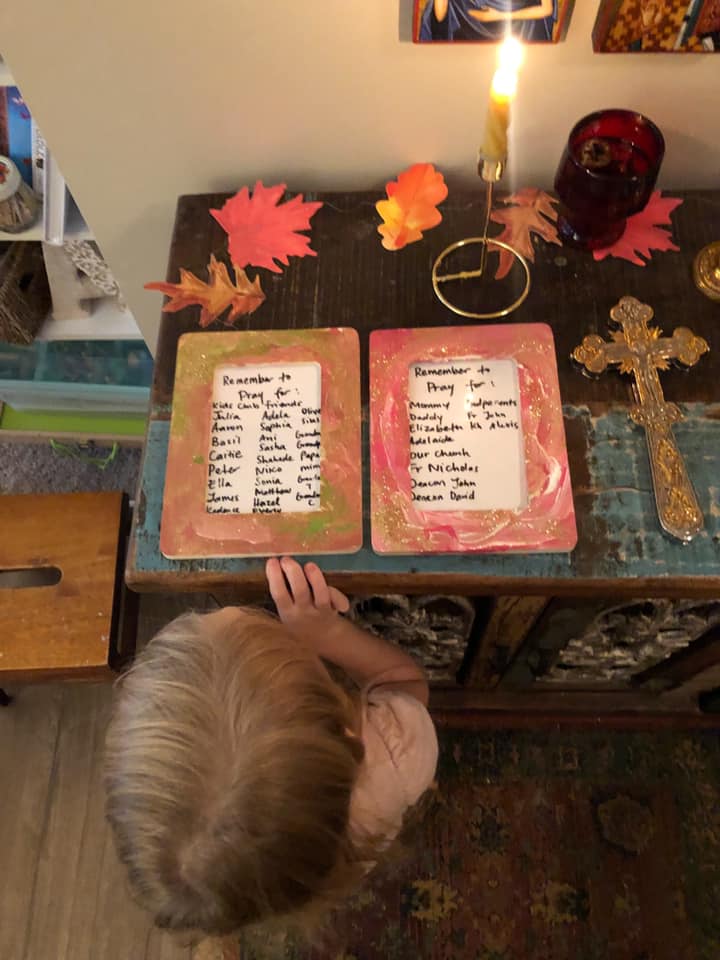
A major highlight was “banana sushi” which Mrs. Caitlyn showed them how to make out of dessert items around the house and we talked about the origins of all those items and how we can remember to pray for people in those places all over the world! Then Mrs. Caitlyn showed us how to decorate a frame so we can keep a list on our altar of names of people we want to pray for. I will cherish those little frames forever! They turned out beautifully!

As I said, it was engaging, interactive and I even ended about learning more about a saint that I didn’t know very much about. I’m thankful for all the hard work that Mrs. Anna-Sarah, Mrs. Caitlyn, and Mrs. Sueanna put forth to make this program fun for my girls, and for other families in our Diocese (DOMSE). God bless you all!"


Wednesday, June 17, 2020

When Directing a Small Church School, Be Excited and Stay Flexible!


Interview with Yuliya Warner: “When Directing a small church school, be excited and stay flexible!”

Yuliya has served as Sunday Church School Director at St. Anthony Antiochian Orthodox Church (Melbourne, FL) for six years. She was also the primary teacher for the program. Students meet in the same classroom and share a lesson, with an average attendance of 2-8 children per Sunday.

Which curricula is used for Sunday classes?
I use Orthodox Christian Education Commission materials as a base, along with various online resources to create my own lessons, since at times the students range in age from 4-17 years old. In addition, I occasionally use the Sunday Gospel for Children from Let Us Attend on the Department of Christian Education website (I add it to the bulletin with either a crossword puzzle or coloring page).

How do you organize a lesson that works well for all ages since you don’t know in advance which ages of students will be attending on any given Sunday?
I prepare for all ages just in case. We have a computer and printer available at our church, so if something unexpected comes up I can quickly adjust and print more materials. Also, I always keep various craft materials in our classroom.

Please describe one or more of the ways that you communicate with parents about Church School so that they feel connected even if their children are not able to attend on some Sundays.
We connect by email, text, or phone call. I email links with our weekly news announcements (I do “St. Anthony’s News” email on Sunday and the weekly bulletin, so I can add Sunday school news and materials to it). For the Creative Arts Festival, if children are not there for a period of time, I mail materials with a prepaid return envelope (this works better than just emailing a link for Creative Arts Festival to the parents).

Please describe a Church School event that happened outside of church.
All the kids were invited for a trip to the zoo. All costs were covered by the Sunday school fund. We had only two kids (ages 4 and 12) and one parent. Our theme for the trip was the beauty and wonder of God’s creations. We fed a giraffe, saw wonderful animals, and got to explore nature. We took a short break to share food (I had a cooler with food and drinks). Fr. Elia joined us for lunch and led us in prayer before the meal. We sat on the rocking chairs by the lake, watched the fish and birds, and talked about life. There is a lot to say about our trip. It was so much fun! I love field trips because they help us to get to know each other better. At the end, we had even more fun running to the car in the rain. The feeling of togetherness and friendship is the best!

What advice do you have for directors who are building church schools in small parishes? 
There is no formula, but I would say don’t get discouraged, stay excited, be flexible, and make more community events to show what you have to offer. People move constantly, so try to keep in touch with kids who left. Let them know that they have a home at your church and that they are loved by their church family. Also, work together with your priest to further improve church schools.

What is a short-term goal that you have for St. Anthony Church School?
The attendance is very inconsistent, so it is difficult to make plans. I would like to have a computer in our classroom to engage my students and increase participation.


Church School activities outside the classroom:
Camp days: Fr. Elia and I make three camp days throughout the school year. First, we come up with a theme. For example, our last theme was “Priest’s Vestments”. Next, he prepares a conversation about it. Sometimes I send him my ideas and links to look at. During camp, we pray in the morning, have breakfast together, then go in for Abouna’s talk, and do some Q&As. After the talk, I have a conversation with the kids about Father’s speech while making a themed craft or poster. We show our creations on Sunday to the whole parish by putting it on our bulletin board. 
Field Trip: Fr. Elia and I always make sure to plan at least one field trip during summer.
Christmas play: We do a Christmas play every year. Sometimes just kids, sometimes with the whole parish (whoever wants to participate). I usually conduct the play, but anyone can give advice, help with music, costumes, props, or suggest text for the play (which I often alter to fit our small parish).
St. Ignatius Dinner and Special Olympics Fundraiser: We organize a luncheon with kids and parents to raise money. 
Holiday celebrations: I ask children, teens and parents to get involved with cooking and decorating for holiday events.
Angel Tree: In November, children, with help from the adults, decorate our Christmas tree for the Salvation Army angels. After that is over and gifts are delivered, we decorate it for Christmas. I try to get all of our children, big and small, involved in the life of our Church.
Feast Day Lessons: Every week before a Feast day, I put together a lesson to educate the children about certain details to pay attention to during the service. We usually cancel Sunday school for Feast days, so children can witness and learn our traditions and services. I am usually involved in organizing Feast celebration luncheons, so I ask the children to help with flower arrangements, setting up tables, and decorations. 

In our small Church there is always enough work for everyone. Participating in all activities teaches children to love one another, be attentive, and serve God by serving others. We are a Church Family.