Tuesday, April 17, 2018

Book Review: Removing Barriers

Removing Barriers: A Step-By-Step Guide to Making Your Parish More Disability Friendly (a Faithtree Resource)
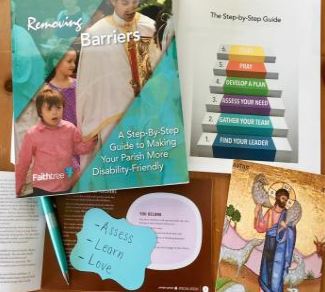
Take time to purposefully consider whether or not your parish is disability-friendly…Once you have given thought to the subject, you’ll likely be aware that there are many areas of parish life to evaluate when determining whether any barriers are present which could prevent full participation for a person or family living with a disability. Barriers can be physical, attitudinal, or even programmatic. (Programmatic Barrier: “any program that cannot be accessed by persons with disability has a barrier that must be considered and intentionally removed.” page 47) So, after completing the analysis of where your parish lands on the disability-friendliness scale, now begins the task of removing existing barriers through education and physical changes. The book Removing Barriers: A Step-By-Step Guide to Making Your Parish More Disability Friendly (a Faithtree Resource), is available to guide your efforts from an Orthodox Christian perspective.
What exactly is a Removing Barriers Effort (RBE)? “More than a special program or a ministry team, a Removing Barriers effort constitutes an ongoing, organized plan for every person to feel welcomed, valued, included and fully able to participate in the Life of the Church, because barriers that might prevent them from doing so have been intentionally removed. The goal is to transition from a place of ignorance or pity into a congregation of co-laborers that serve Christ and His Church together.” (page 16)
Why begin an RBE within your parish? According to the Center for Disease Control, one in five Americans live with or are affected by disability. That is a significant percentage of persons within our country, within our parishes, who are struggling with barriers – significant enough to garner attention within the Church.  Oftentimes, families find our churches unprepared, unmindful, or unsure of how to remove barriers that prevent participation. Removing Barriers: A Step-By-Step Guide to Making Your Parish More Disability Friendly points out that“God gave us direct instruction throughout Holy Scripture that repeatedly reminds us of how much He values our love for each other. We hear again and again that God’s expectation of His people is that we provide for each other, and specifically, that we bear one another’s burdens (Galatians 6:2, Philippians 2:4, James 2:14-17) …If we as the Body of Christ here on earth fail to include and incorporate every person in the worship, edification and evangelism in our communities, likewise, we are not functioning as God intends or commanded.” (page 19)
Furthermore, our leadership commands that parishes begin the work of removing barriers. The Standing Conference of the Canonical Orthodox Bishops in the Americas (SCOBA) put forth a statement in 2009 regarding persons with disabilities and including them in the life of the Church. The full statement is on pages 20-25 of Removing Barriers: A Step-By-Step Guide to Making Your Parish More Disability Friendly. A key excerpt reads “…A person with a disability is not necessarily handicapped except through physical and attitudinal barriers created by others. Handicaps are in fact the barriers that we create for people with disabilities by excluding them socially and physically. There are many persons with disabilities even in our own parishes; nevertheless, our parishes have not reached out sufficiently to adults and children with disabilities in its ministry.” (pages 20-21)
How to begin an RBE effort: Fortunately, the book provides a step-by-step guide for planning, forming, and implementing an RBE effort at your parish. Six steps are listed (page 33), along with detailed instructions for each step.
  1. Find your leader
  2. Gather Your Team
  3. Assess Your Need
  4. Develop A Plan
  5. Pray
  6. Start
Then, going a step further, instructions are included for constructive results ranging in levels from “no fundraising required”, all the way to “the project requires a strategic team and grant writing may be necessary.” (pg. 54) Seemingly small changes that yield immediate impact include adding welcoming language in the Sunday bulletin, creating a designated section for congregants with sensory sensitivity, or creating a buddy system for children in church school or youth program. (page 54)
Also included in Removing Barriers: A Step-By-Step Guide to Making Your Parish More Disability Friendly is a Basic Disability Primer (page 74-89), which reviews some of the most commonly-experienced disabilities and helps the reader better understand feelings, perceptions, and needs of parishioners living with disability. Even if your parish is not ready to form an RBE team or effort, this Basic Disability Primer is a valuable resource to share with Christian Education staff and leaders of other parish organizations.
Another resource to share with parish leaders and Christian Education staff is the list of 75 Strategies to Help Your Removing Barriers Effort (page 90-98). A suggested list of strategies that can aid Sunday church school teachers during class and make an immediate difference is:
-        Ask family members about unusual or inappropriate behavior. Parents can help you understand what the child may be trying to communicate, and how you can respond in a helpful way.
-        [Sunday Church School Directors:] Provide ongoing opportunities [for staff] to exchange information, share wins or concerns, and communicate regularly about how the Church can best serve the person and family.
-        Have realistic expectations.
-        Teach visually whenever possible.
-        Remember, in the church school setting, patience, consistency, and caring will bring progress. Don’t be discouraged if your student prefers to sit and watch instead of participating. They will benefit just by being at Church and in your class!
-        Be patient and respectful when someone with a communication disorder contributes in class. Give them time to respond. Through your example, help the class realize that he or she is an intelligent person who can share valuable insight and ideas.
-        Create a “buddy system” as a strategy that can bless persons with disabilities, their families, and the buddy!
Because the subject of removing barriers at a parish-wide level is so broad, it can easily seem overwhelming. By following the RBE method, goals of all levels can be created and achieved, even when starting small. By educating the parish on existing barriers and how to remove them, then “everyone is equipped with the knowledge to ensure safe learning and a clear understanding of the ministry, why we are serving, and what it means to be in true fellowship with one another.” (page 101)
To order Removing Barriers: A Step-By-Step Guide to Making Your Parish More Disability Friendly and begin the improvement process within your parish, visit www.faithtree.org. In addition to this book, Faithtree Resources continues to work at creating other resources to help churches become more disability-friendly. To stay informed of their newest materials, visit www.faithtree.org or email info@faithtree.org. Direct support from the Antiochian Orthodox Department of Christian Education (AODCE) is available by contacting Anna-Sarah Farha at aodce.csdirectors@gmail.com. Facebook groups organized by the AODCE for Sunday Church School Directors and Sunday Church School Teachers provide the opportunity to discuss removing barriers in Sunday Church School from an Orthodox Christian Education viewpoint in a supportive group forum:

Friday, March 9, 2018

Coordinating/Organizing a Small Church School Program

The Orthodox Christian Education Commission (OCEC) has provided suggestions within their 2017-2018 Curriculum Catalog for coordinating a church school program for parishes with small church schools - perhaps a one classroom school, or between two and four classrooms. 

The link to their catalog plus order forms can be found here: 
http://orthodoxchristianed.com/files/4114/9885/4473/ocec2017_2018.pdf

Quoting from page three of the catalog:

Not all churches have enough children to allow for separate grades in the church school. Several grades must be combined together in the same classroom. The open classroom concept is hardly new and has been developed in the public schools for years. It helps for us to think of those small schools as a small family living and learning about God together. A basic lesson can be taught to the whole group, and then children divide up into small groups or individually, according to age, work abilities, and interests. Projects all play a great part in such situations, and these activities must be worked out in advance and student-initiated. Older students need more challenge to understand and study the theme or concepts on their own level, at their own speed. Younger students need more teacher guidance and involvement. Here a few ways to organize this using the OCEC materials.

One Classroom School 
Although one class is possible, it is better to divide up into at least two groups for lessons. Where this is not possible, the home study book “Way of Life: Introducing Your child to the Orthodox Faith” can be used as an umbrella program for all ages. The material can be used as an umbrella program for all ages. The material can be divided to cover two years. The themes are the section headings from the book. [Throughout the catalog,] The books in italics are OCEC manuals that can be used. 

First year: Church—New Life in Jesus/New Life in the Church; Advent/Nativity—In the Beginning; Lent/ Pascha—Making Things Right/Jesus, the Promise of God 
Second year: Feast—Together with God; Home—The Wonder of it All/God, My Friends & Me; Major Saints— God Loves Us/Our Life in the Church 

Note: In the following sections the first book mentioned should be used this year. Other books can be used in succeeding years. Pre-school children have such unique needs that no matter the number, they should be placed in a separate area, using Pre-school manuals.

Two Classroom School 
1. Kindergarten–Second Grade Use Together With God; Then God Loves Us, New Life in Jesus/Making Things Right 
2. Third–Sixth Grade Use New Life in the Church; Then Jesus, the Promise of God, Our Life in the Church, In the Beginning 

Three Classroom School 
1. Pre-School–First Grade Use The Wonder of it All/God, My Friends, & Me; Then Together With God; Then God Loves Us 
2. Second–Third Grade Use New Life in Jesus/Making Things Right; Then New Life in the Church 
3. Fourth–Sixth Grade Use Jesus, The Promise of God; Then Our Life in the Church, In the Beginning 

Four Classroom School 
1. Pre-School–First Grade Use The Wonder of it All/God, My Friends, & Me; Then Together With God; Then God Loves Us 
2. Second–Third Grade Use New Life in Jesus/Making Things Right; Then New Life in the Church 
3. Fourth–Sixth Grade Use Jesus, The Promise of God; Then Our Life in the Church 
4. Sixth–Seventh Grade Use In the Beginning; Then Young Church 

Teens—Separate programs and classes should be arranged. Where numbers are very low, youth could serve as junior teachers with responsibility of helping and mastering the content.

Monday, February 19, 2018

Pinterest Lenten Resources for Orthodox Christian Church Schools

Blessed Fast!

St. Basil the Great’s Hymn of First Monday of Lent
“Let us fast an acceptable and very pleasing fast to the Lord. True fast is the estrangement from evil, temperance of tongue, abstinence from anger, separation from desires, slander, falsehood, perjury. Privation of these is true fasting.”


The Antiochian Orthodox Department of Christian Education has Pinterest boards specifically organized and dedicated to aiding church school staff and parents during the Lenten Season. Click on the links below for direct access.


Great Lent

Fasting

Holy Week

Pascha


Thursday, February 1, 2018

Interview with a Director of a Small Church School

Are you wondering what is it like inside other small church schools? 
How are they creatively working with resources...
How do they structure classes...
What curriculum/technology is being used...
What types of humanitarian projects are they doing...

The Antiochian Orthodox Department of Christian Education (AODCE) has an ongoing series of interviews with church school directors throughout the Antiochian North American Archdiocese. Interviews can be found at: 


The most recent interview in the series is with Laila Ferris, director of the (small) church school at St. George Orthodox Church in El Paso, Texas. An abridged version is posted on the AODCE website, and the full version is available to you here:

Interview with Laila Ferris: Integrated Learning in the Digital Age

Laila Ferris has devoted 25 years and counting to serving as church school director at St. George Antiochian Orthodox Church, El Paso, Texas. Presently, there are 37 students enrolled and classes are organized by groups of two grade levels, plus grades 8-12 together as one class.

Which curricula do you use for Sunday classes?  
We use a combination of curricula/materials from the OCEC and from the Greek Orthodox Archdiocese to support our students’ learning.  We also use online lessons provided by our Archdiocese Department of Christian Education.  The teachers develop lesson plans that use active and engaging learning activities through which the lessons are taught and learned.   We are presently working towards developing more opportunities for learning activities via apps and web-based programs for our students (as the digital generation) to expand their learning experiences.  Our plan is to be able to purchase iPads for use in the classrooms to support digital projects. But in the meantime, the church school staff will continue to use their personal devices to grow our instructional lessons digitally.

Are there any ethnic components to your church school/Christian education ministry?  
We have a diverse ethnicity among our students, whose connection to each other is their faith.  We incorporate ethnic diversity in our lessons with our students for Feast day celebrations/family traditions and music.  For example, in preparation for Pascha, our children learn to sing "Christ Is Risen" in English, Arabic and Greek, as well as learning the responses to "Christ Is Risen, Indeed He Is Risen" in languages other than English.

Does your church school participate in Humanitarian projects as a group?          
Our church school supports and participates in our parish's and Teen SOYO's Humanitarian projects such as food drives, clothing drives, and toy drives. We also participate in our parish's annual Senior Citizen Christmas Dinner and Dance. Every December, approximately 400 community senior citizens living in Federal Housing Authority retirement centers attend. Students pack goodie bags for the senior citizens, serve them at the dinner, assist them in several ways, and even dance with them.  We feel that connections are important to the well-being of many people, but the actual act of serving others, in person, will give our students life experiences which will grow their sense of empathy in the Christian way. This is an integral part of who we are to be and following our faith in becoming servant leaders.

What are some church school challenges/issues that you did not expect to encounter, and how have you addressed them?   
Challenges provide us with learning experiences and allow us to become better at what we do to support the teaching and learning of our faith with our students.  Challenges we have experienced are inconsistent attendance with some students over the years, and students not being on time for opening prayer with our parish priest. The church school staff have been diligent in letting students know that we miss them when they and their parents are not present.  We have implemented an incentive program for students who are present before opening prayer, known as our "Bible Buck" program. Students earn one "Bible Buck" for every Sunday that they are present prior to opening prayer.  We open our "Bible Buck" store for students to purchase religious items for themselves or family members.  The students now remind their parents to make sure that they get them to church school on time.

How does your parish show appreciation for church school staff?  
   Our parish family is truly supportive and appreciative of the church school staff. Their appreciation is shown through their support of the church staff's work by assisting, attending, contributing towards the staff's activities and classroom materials, and so on.  Their appreciation is also shown through words of thanks as well as "no" never being a part of their vocabulary for whatever may be needed by the staff.


What type(s) of training and resources specifically for church school directors can you recommend?
I believe that time is critical to ensure that church school staff can plan and discuss the upcoming year, share successful lessons and information, and work together as a team to support all the students in our church school.  I also feel that it is important for the church school staff to use their abilities and knowledge to engage the students in learning about their faith through a variety of resources and instructional methods. These include hands-on activities, digital activities, and creative projects.  The teacher/student relationship is also important. Church school staff need to get to know their students, their families, their interests, and their abilities. We can then better serve them through the right variety of resources and activities, and ensure their growing understanding of the Faith, not only in church school, but as they participate in Liturgy and practice at home and in their everyday life.  The responsibility to teach the children and teens of our parish is an awe-inspiring responsibility and the trust given to us to teach them is truly honorable and humbling.  We constantly remind ourselves of the quote stating, "our children are our future". But I also believe that they are our "present" which makes our work with them even more important, for the what occurs in the present ultimately impacts the future.  Hence, what we teach and what the students learn today, alongside their families, the parish priest, and the parish family, is how they will grow in their faith so that they may become followers of Christ for all of their lives.


Wednesday, January 24, 2018

Chapter Six: Guiding Principles

Christian Education in the Small Membership Church
Karen B. Tye
Chapter Six & Postscript Review by The Mustard Seed

We’ve covered a lot of material, considered many factors, focused on important guidelines, and widened our understanding of teaching and learning as we strive to build/improve the Christian education ministry within our small membership churches. Even though we already know this, it bears repeating: there is no one right way to do Christian education. So, what do we need to keep in mind as we educate in the small membership church? What guiding principles should remain before us as we think, dream, plan and do this important ministry? Certainly we refer often to the who, what, where, when, and how of Christian education as reminders of our mission. Additionally, the author provides big-picture insight and inspiration for education in the small church. Share these lovely quotes with your teachers during the year.

“Our small size is to be celebrated and cherished for the gifts it brings. We aren’t just a little church, or we don’t just have forty in worship on Sunday. We are a cell in the Body of Christ and can faithfully educate our members to do and live as God would have us. Small is beautiful.” (p. 84)

“Our work is to know and understand our particular small church and, working as a team with others in the church, to think through together what will work and what won’t in our educational ministry.”        (p. 85)

“Every community that wants to last beyond a single generation must concern itself with education…Whatever our size, education is essential in the community of faith.” (p. 85)

“Too often the resources we already have are hidden from view because we are focusing so much on what we don’t have…It is really a matter of learning to see in new ways. To use what we have, we have to see what we have. So start looking – you will be surprised at what you find!” (p. 87)

“Innovate, avoid ruts, adapt, and keep it interesting. That’s what the principle of imagine and improvise is all about.” (p. 87)

“…we don’t wait until failure is upon us to pray. Christian education in the small membership church is rooted and centered in prayer from the very beginning. Prayer reminds us of who’s really in charge here.” (p. 89)

“We cannot be too small to be faithful to God’s call. We cannot be too small to carry out effective Christian education. Without apology and without excuse, may we carry out the work of Christian education in the small membership church, knowing that God is with us and the world awaits. May we be faithful to the task!” (p. 91-92)

All quotes within this series of reviews are from the book “Christian Education in the Small Membership Church”, by Karen B. Tye, which is available for purchase through Amazon, Barnes & Noble, and Books A Million. The book was reviewed by Anna-Sarah Farha, an associate of the Antiochian Orthodox Department of Christian Education. Anna-Sarah enthusiastically supports the needs and efforts of Sunday Church School Directors and can be reached at aodce.csdirectors@gmail.com. For further support, join the Orthodox community of church school directors on Facebook: https://www.facebook.com/OrthodoxChristianChurchSchoolDirectors

Let us, as educators and church school directors, consider the words of St. John Chrysostom from his Lessons of Education, “Having children is a matter of nature; but raising them and educating them in the virtues is a matter of mind and will…Your children will always be sufficiently wealthy if they receive from you a good upbringing that is able to order their moral life and behavior. Thus, strive not to make them rich, but rather to make them pious masters of their passions, rich in virtues. Teach them not to think up illusory needs, reckoning their worth according to worldly standards…The youth to whom you give a good upbringing will not only enjoy general respect, he will also become dearer to you yourselves! Your attachment to him will not be a mere natural attraction -- it will be the fruit of his virtue.”


Tuesday, January 16, 2018

Chapter 5: Resources

Christian Education in the Small Membership Church
Karen B. Tye
Chapter Five Review by The Mustard Seed

“When we take a careful look at it, there is a lot at hand in terms of resources that can help us do the work of educational ministry in the small membership church. It is all in how we look at it.” (p. 69)

The topic of resources may seem overwhelming or discouraging to a small membership church, but we'll focus on three categories that are already available to us: people, space, and curriculum. Let's embrace and utilize what we know we have within our own parishes, and also learn about the resources available through the Antiochian Orthodox Department of Christian Education (AODCE).

People
“We overlook the human resources and the role they play in Christian Education. Rather than overlooking them, we need to see that people are the most important resource we have.” (p. 70)

Recognizing and acknowledging the importance of our brothers and sisters in Christ within the parish in regards to Christian education is an important step; so, what else should we consider about them? We need to determine how this human resource blessing can be best used within our ministry. And to determine how to best engage people in the most helpful ways, we'll look at three clues that are especially helpful in the small membership church: teachers and leaders are called, we should use a team approach, everyone has gifts to share.
1.      Teachers and leaders are called: “There are those within our small membership church who display a deep love and respect for others, who have a passion for the gospel and for sharing it, who love to learn and invite others to love learning too. All of these are key qualities for those who teach and lead.” (p. 71) Once a teacher answers the call to teach within your Christian education ministry, be ready to support them by providing resources for the task, which we’ll soon cover more in-depth. Also, let them know that you value their time. “If the conventional Sunday school format on Sunday morning does not work in your church, you don’t waste a teacher’s time trying to make it happen. Instead, thought is given to doing education in other ways and helping those called to teach to use their gifts appropriately in different contexts.” (p. 71)
2.      Use a team approach: The author reminds us that Christ used a team approach in His work through the disciples, sending them out two by two (Mark 6:7). Likewise, we should never attempt to do this work alone. “Working as a team, the small membership church recognizes that everyone is a vital resource in the ministry of Christian education.” (p. 72)

Everyone has gifts to share: Church schools need people resources in addition to teachers. Often, parishioners feel that they have nothing to offer to Christian education because they are not called to be teachers. “Too often we look at what we can’t do rather than focusing on what we can do.” (p. 72) Remind them that we all have a gift to contribute to the work of education within our parish and no gift is too small in the eyes of God. Endless opportunities exist.

AODCE People Resources
The AODCE supports church school directors, teachers, parents, and all who participate in the work of Christian education at the local level. Each diocese within the North American Archdiocese has a Diocesan Coordinator available to assist parishes in organizing a church school and training its staff. Church school directors have a direct line of support through an AODCE associate who is focused on serving the needs of directors. Support is also available for the Creative Arts Festivals at the parish level. For more information, visit www.antiochian.org/christianeducation.

Space
“Space of any kind is a resource if we are able to see the possibilities in it. Our goal is space that is alive and conducive to being, playing, studying, praying, and working together.” (p. 73)

            Space can be in short supply in a small membership church, but let’s focus on quality over quantity. Almost any space can be transformed into a workable area for Christian education with a little vision, a little creativity, recycling/upcycling, a little paint. Small spaces can be made functional and inviting. The author gives an example of how a single classroom was transformed into a one-room school environment by adding a painted wall mural, placing a small platform in a corner for dramas and role plays, creating a craft area in another corner with a table and chairs, and using a remnant of carpet on the floor to define a story-telling area. When planning how to best use your space resources, first consider an area’s physical space, which is “its possibilities and limits, its condition, and the ways in which it facilitates our educational work.” (p. 74) Secondly, we should give equal consideration to emotional space, “the feelings and attitudes people experience in a particular environment.” (p. 74) Basic cleanliness and furniture/structures in good repair is the bare minimum. Invite students into an environment with sights, sounds, smells, and textures that will excite them and stimulate learning. Welcome them with warmth and care, and provide boundaries for “a sense of security, letting us know what we can count on in this space.” (p. 76)

Curriculum Materials
“There are some intentional and deliberate steps we can take that help us think through our needs, review the resources out there, and make good use of them…We take time to think about our congregation and what we want in the materials we choose. “ (p. 78)

            It is important to not feel trapped into thinking that because of limited financial resources Christian education ministries of small membership churches must settle for whatever curricula they can find and afford. It is important to remember that curriculum materials don’t teach; people do. Space teaches, too. This is why we’ve already discussed that people are your most important resource and preparing a proper space for learning is another critical step in building a healthy, productive educational ministry. Now, with that having been said, there are ways to explore various curricula and discover which resources best fit your parish’s needs.
1.      Get samples of the materials you are considering and spend time reviewing them.
2.      Make the review process a team effort with the leadership of your educational ministry.
3.      Explore the use of Orthodox Christian children’s literature as a curriculum resource.
4.      Receive an introduction to several popular curricula options plus corresponding order forms and recommendations for usage on the Curriculum page of the Antiochian Orthodox Department of Christian Education: http://www.antiochian.org/category/christian-education/curriculum.
5.      Request feedback on the pros and cons of specific curricula from church school directors and church school teachers through the social media pages on Facebook dedicated to these types of discussions: https://www.facebook.com/OrthodoxChristianChurchSchoolDirectors/ and https://www.facebook.com/orthodoxchristiansundaychurchschoolteachers/.
6.      Access a full list of Orthodox Christian education resources on the Antiochian Orthodox Department of Christian Education website: http://antiochian.org/online-resource-list-parents-and-teachers
7.      Download a full manual for church school directors from the Antiochian Orthodox Department of Christian Education with a dedicated chapter to curriculum and resources: http://www.antiochian.org/sites/default/files/csdmanual2011.pdf.
8.      Once you’ve chosen curriculum, ensure that staff and volunteers are properly trained on how to use the materials.
9.      Supplement your lesson plans with church school activities found on the Antiochian Orthodox Department of Christian Education Pinterest page: https://www.pinterest.com/aodce/
10.  Evaluate how the curriculum is working. On a regular basis, check with teachers, parents, and youth and ask for their observations. We don’t wait to evaluate until a problem arises.

Further Reflection (p. 80-81)
  1. How do you currently find the teachers and leaders you need for Christian education? What have you learned in this chapter that helps you rethink this?
  2. Gather a group of people committed to Christian education in your church and take a walking tour of the Christian education space(s).
·   Look at the physical conditions. Where is there a need for cleanliness and repair? Who will be responsible for this?
·   In what ways does your space reflect hospitality, openness, and safety? What could be done to enhance these qualities even more? Who are the people in your parish who can help make this happen?

Summary
  • People are the most important resource in Christian education.
  • Every parishioner within a small membership church has a gift to share as part of the educational team. Even the smallest gesture can make a difference.
  • Space is a resource, not a problem. By taking care of the physical space and devoting attention to the emotional atmosphere, an enjoyable learning environment is formed.
  • Curriculum resources are an important tool for Christian education. We must take time to review and select the right materials for each of our unique small membership churches. The next step is to properly train teachers and volunteers, then continually evaluate how the curriculum is working within our educational ministry.
Up Next…
We will review the final chapter and postscript of “Christian Education in the Small Membership Church,” which will cover several of the author’s guiding principles for establishing a successful Christian education ministry within your parish, much like a concentrated summary of all the topics we have studied in greater detail in previous chapters.

Monday, January 8, 2018

Chapter 4: How: Clues to Education in the Small Membership Church

Christian Education in the Small Membership Church
Karen B. Tye
Chapter Four Review by The Mustard Seed

“…carrying out educational ministry in the church cannot be reduced to a step-by-step process and…there are no guarantees!” (p. 55)

How do we do Christian education? When considering the “how” of doing Christian education, we must think and reflect on the issues we’ve already addressed, such as who are the people we educate, where does education occur, what is our concept of education and how does that concept shape what we do. This is when the clues as to “how” to organize Christian education within our own parish start to appear. These clues will likely be unique to your own parish. Additionally, the author outlines five basic qualities along with two vital capacities, plus the use of story and ritual as essential components to doing Christian education in the setting of a small membership church. The five qualities are: experiential, reflective, relational, inclusive, and integrative. And the two capacities are imagination and improvisation.
  1. Experiential – “We learn best when our whole selves are involved, when we see, speak, listen, move, smell, touch, and taste…Whether our setting is the Sunday school, the worship service, or an event in the life of the church, we need to think about how we invite the whole person into it.” (p. 57)
  2. Reflective – “Experience alone isn’t enough…The brain can take in only so much material before it needs to reflect…Reflection involves head and heart, both thinking and feeling…Building in opportunities for reflection on both thoughts and feelings is vital to education…The small membership church already knows that numbers are not the most helpful measuring rods for success. So it doesn’t matter how much we cover in a lesson or how long the sermon is. It is more about how well we come to know and understand what we’ve heard and done.” (p. 57-28)
  3. Relational – “Education is rooted in relationships…The small membership church is rooted in relationships too…What we need is to be intentional about this relational quality of the church and to build on it in important ways when we organize our educational ministry.” (p. 58)
  4. Inclusive – “By its very nature, the small membership church lends itself to an inclusive Christian education…We include all ages together to do something. Such a perspective frees us from having to look like the larger church with its multiple classes, separate youth groups, and long list of group-specific activities.” (p. 59)
  5. Integrative – “The small membership church needs to recognize that everything we do is educating and become intentional in working toward a holistic approach to its educational ministry. Planning church school, worship, and the various congregational events should be seen not as activities separate from one another but rather as all being a part of the educational work of the church.” (p. 60)
Now we should consider two capacities that are key to learning and can be quite helpful in planning and doing education in the small membership church. Fortunately, we all possess these capacities, even if we have to dig deep to discover our natural abilities. These capacities are imagination and improvisation. “Part of the work in learning to do education in the small membership church is recognizing, nurturing, and using these capacities. They provide vision and energy to see all the opportunities and possibilities for educating present in the small church context.” (p. 60-61)
  1. Imagination – “[A] small variation in the routine can be exciting and wake up those brains that have become less alert because of routine…Invite as many people as possible to help you imagine. New eyes can see things that familiar eyes miss…Welcome curiosity and questions…Too often we think education is about answers when it is the questions that are critical. Learning to ask questions and explore possibilities engages the imagination and helps us see, learn, and discover new ways.” (p. 61-62)
  2. Improvisation – “Improvisation is the capacity to act and to create in the moment in response to what is in one’s immediate environment…It can be very useful in the small membership church to help us take what we have and create educational ministry out of that, rather than worrying about what we don’t have and getting stuck in our complaints. Improvisation calls for attention to the moment and what is going on now. It asks that we take inventory of who we are, what we have, and think about the possibilities present in all of this.” (p. 63)
Lastly, after working through the qualities and capacities, we come to story and ritual. As Tye writes, “Small membership churches are places of story, and there are important stories to tell...How do we do education in the small membership church? We tell stories...Rituals are an important part of this storied process too...The way we begin our church school class, the prayer said before a meal, and order of worship we use, the way we pray in church, the devotional before a committee meeting – all of these are examples of rituals in the life of the church...Helping people see the stories represented in our rituals is a vital educational task.” (p. 64-65) Reading the author's words about story and ritual should resonate with us as Orthodox Christian educators. Ritual is a familiar, comforting, and natural part of Orthodox worship. Sharing the stories (Biblical and historical) represented in Orthodox rituals with students opens the door to learning our rich history and to deepened knowledge and understanding of the Faith.

Further Reflection (p. 66-67)
Engage in a brief writing exercise:
  • Write the following on a piece of paper: “My church is...” Then start writing, putting down whatever comes into your head. Write for five minutes. Do not edit or worry about things like spelling or grammar. Just write!
  • Make a list of the characteristics and qualities describing your church that are mentioned in your writing.
  • Compare your list to the five qualities discussed in this chapter: experiential, reflective, relational, inclusive, and integrative. In what ways do the five qualities describe your church? In what ways is your church different?
  • How are the qualities you've listed for your church influencing the way educational ministry is carried out there? How might you imagine doing it differently?
Summary
  • While there is not a one-size-fits-all-small model for how to do Christian education in the small membership church, there are necessary components that must be included in order to maximize the efficacy of our efforts so that the desired result (firm knowledge of the Faith) within our students can be achieved.
  • Christian education must be experiential, reflective, relational, inclusive, and integrative.
  • Educators will discover new opportunities for education when we tap into our abilities to imagine and improvise.
  • Connecting rituals with the stories that they represent will lead students to further comprehension of the Faith and why Orthodox Christians do what we do in the ways we do.
Up Next...
Now that we've covered the Who, Where, When, Why, and How of Christian education in the small membership church, we'll move on to the important topic of resources, specifically “people, space, and curriculum materials.” Discussion will focus on how to best use these resources and how the Antiochian Department of Christian Education (AODCE) can support our efforts through available resources on the AODCE website and social media sites, training opportunities, and curriculum materials.